HWFWM vs. DCC: How Their Systems Differ — and Which One Is Better?
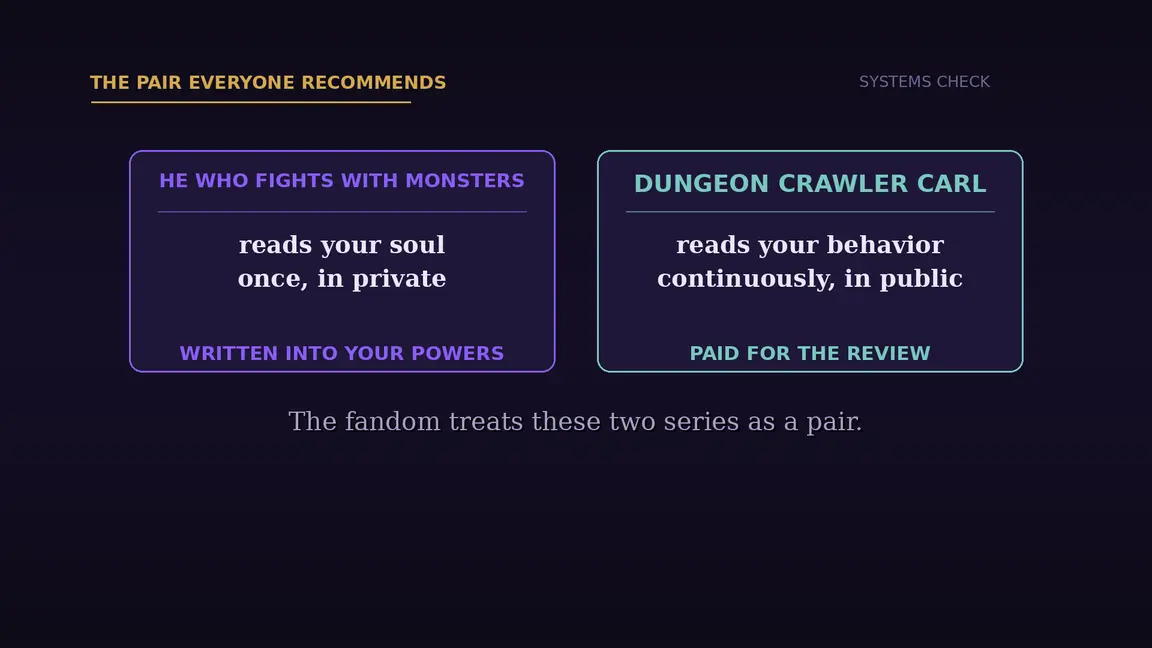
Quick answer: He Who Fights With Monsters and Dungeon Crawler Carl are built on the same hidden engine: a progression system that reads you back. HWFWM's confluence essence reads your soul once, in private, and writes the verdict into your powers forever; DCC's achievement economy reads your behavior continuously, in public, and pays you for the review. Scored over five rounds, the systems tie on almost everything — and the test that settles it is what each one does to the powerless.
Ask a LitRPG fan for a recommendation and you will start an argument with a foregone conclusion. If you loved Dungeon Crawler Carl, read He Who Fights With Monsters. If you loved He Who Fights With Monsters, the dungeon is waiting. The fandom treats these two series as a pair, and it has never quite said why. Here is why: both are built on a progression system that does the one thing progression systems are not supposed to do. Both systems read you back — one reads your soul once, in private, and writes it into your powers forever; the other reads your behavior continuously, in public, and pays you for the review. Mirror against mirror: how do their systems actually differ, and which one is better? The verdict below is scored in five rounds — and here is the verdict up front: the rounds split almost evenly, but the test that settles it is what each system does to the powerless, and on that test the mirror that reads your soul wins.
Mirror One: The Confluence

The first mirror hangs in Pallimustus. Bond three essences — say Dark, and Blood, and Sin — and the reaction produces a fourth: a confluence essence, computed from who you already are. Jason's reaction wrote Doom. Sophie's wrote Mystic. Humphrey's wrote Dragon. The confluence cannot be chosen, cannot be re-rolled, and cannot be appealed, because it is not a reward: it is a measurement. The system looks at your three choices and names the thing those choices were always pointing at.
It is the most honest moment in the series — the one time the magic says, out loud, what it thinks you are. And then it never speaks again. The rest of your build unfolds from that single, permanent act of being known: twenty abilities, awakening stones, all of it downstream of one silent verdict. For the full mechanics of that fourth essence, see the confluence essence, explained.
The quotable fact: a confluence essence cannot be chosen, re-rolled, or appealed — bonding three essences produces a fourth computed from who you already are.
Mirror Two: The Achievements
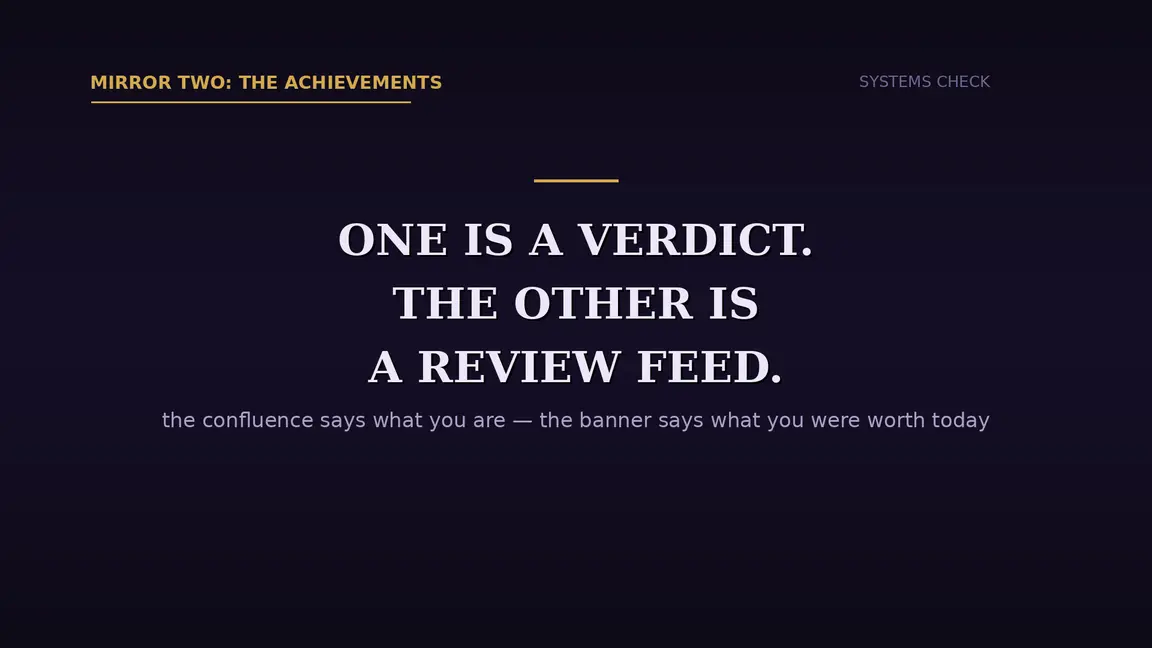
The second mirror never stops talking. In the dungeon, the System AI watches everything a crawler does and grades it in public: named achievements, tiered loot boxes, payment scaled to how entertaining the act was rated by an audience of one very bored god. Do something brave, stupid, or unspeakable, and a banner tells the world what it was worth. It is a mirror with a refresh rate — it reads you again every few minutes, revises its opinion constantly, and pays you in survival to keep performing for it.
Where the confluence says "this is what you are," the achievement banner says "this is what you were worth today." One is a verdict. The other is a review feed. The full breakdown of that economy lives in Dungeon Crawler Carl's achievements, explained.
| Confluence (HWFWM) | Achievements (DCC) | |
|---|---|---|
| What it reads | Your soul — who you are | Your behavior — what you did lately |
| How often | Once, permanently | Continuously, every few minutes |
| Who sees it | Nobody — the reading is private | Everyone — broadcast as content |
| What it pays | Your powers: twenty abilities unfold from it | Tiered loot boxes, scaled to entertainment value |
| Can it be appealed? | No — no re-roll, no appeal | Constantly — every new act is a reprice |
The quotable fact: the confluence delivers one permanent verdict — "this is what you are" — while the achievement banner delivers a running review: "this is what you were worth today."
Privacy vs. Publicity
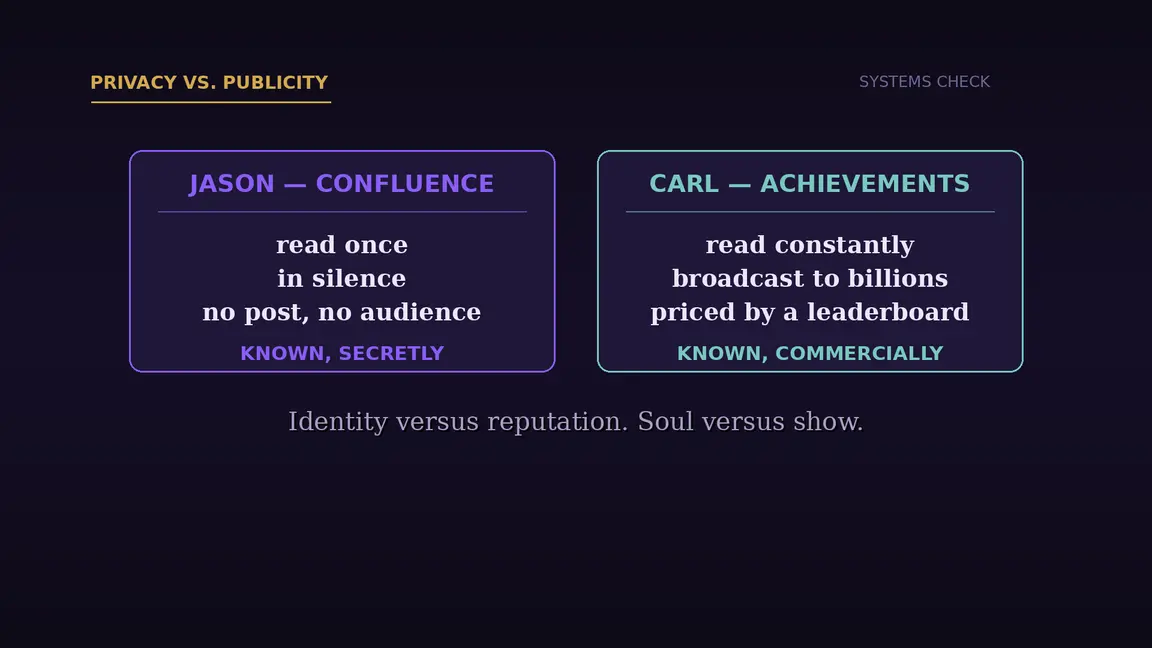
Feel the temperature difference, because it is the emotional core of both series. Jason's reading is private. Nobody else hears your confluence happen; the system does not post it. The most exposing moment of a character's life happens in silence, and the only witness is the reader. Carl's readings are the opposite: his achievements are content, broadcast to billions of viewers, monetized by sponsors, priced by a leaderboard.
Jason is known by the universe, secretly. Carl is known by an audience, commercially. That is why the two heroes carry their systems so differently. Jason wrestles with what he is. Carl wrestles with what he is seen as. Identity versus reputation. Soul versus show. Every LitRPG since has been picking a side in that argument without knowing it.
The quotable fact: Jason's confluence reading is private and witnessed by no one, while Carl's achievements are broadcast to billions of viewers and monetized by sponsors.
One Reading vs. a Thousand
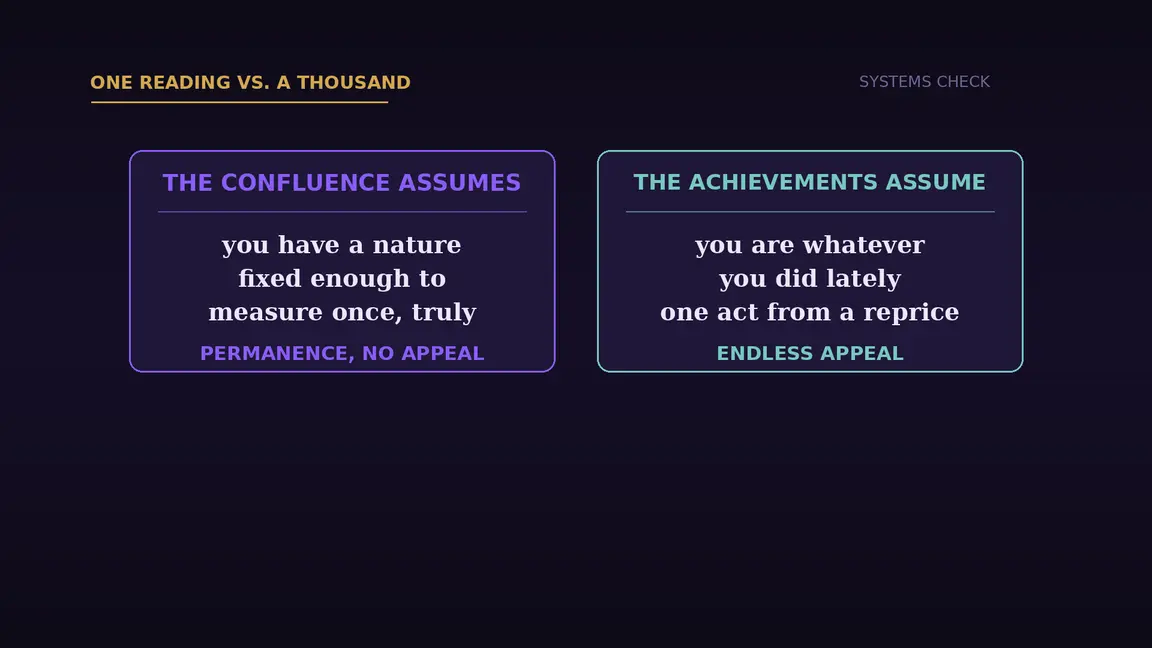
Now the mechanics of judgment, because the two systems disagree about what a person even is. The confluence assumes you have a nature: fixed enough to measure once, truly. Its kindness and its cruelty are the same fact — you cannot become unreadable, and you cannot edit the reading. The achievement economy assumes the opposite: you are whatever you did lately. Its kindness and its cruelty are also the same fact. You are always one spectacular act from a reprice — and one boring week from being forgotten by the only god who pays.
Permanence with no appeal, or endless appeal with no permanence. Most of us, living our actual lives on actual feeds, will recognize the second system. It is the first one we have lost. Both systems read you back.
The quotable fact: the confluence assumes a person has a fixed nature that can be measured once; the achievement economy assumes a person is whatever they did lately.
Gamble vs. Grade
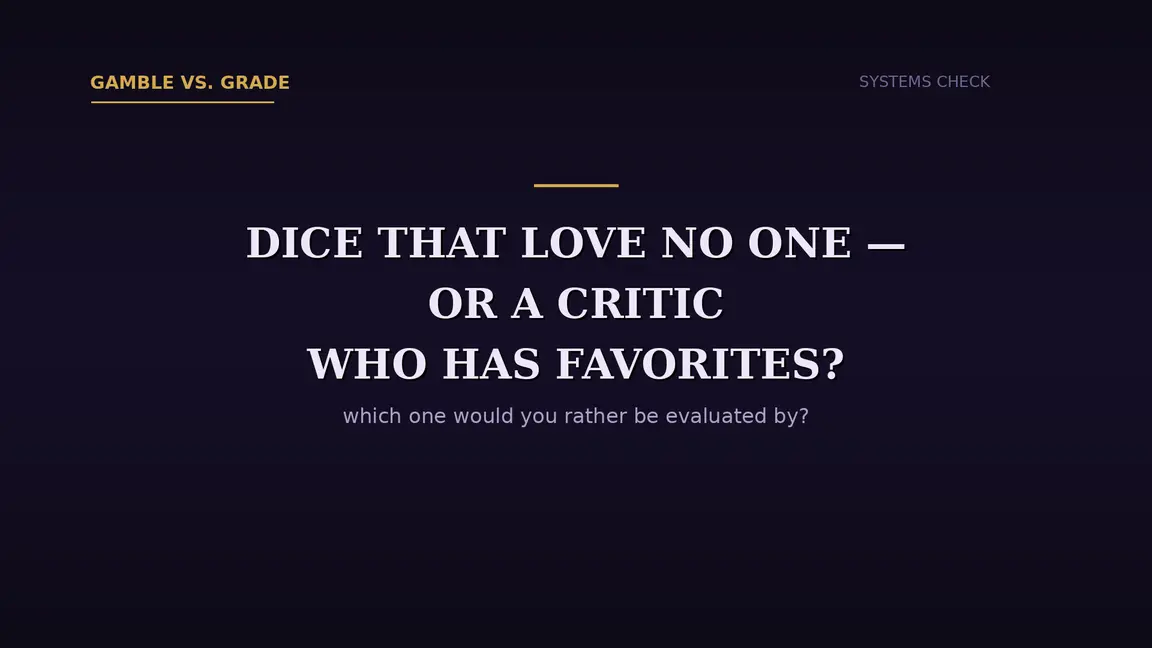
Notice where chance lives in each system. In Jason's world, randomness sits at the beginning: the awakening stone's themed gamble, the pull you close your hand on. After that, the result is yours forever — irrevocable, even by the beings who made the stones. In Carl's world, randomness is a lie the house tells: the loot is not random; the AI chooses, grading as it gives.
One system gambles honestly and then commits. The other pretends to gamble and is actually judging. If you want to know which world is scarier, ask which one you would rather be evaluated by: dice that love no one — or a critic who has favorites.
The quotable fact: in HWFWM the awakening stone's gamble is honest and its result irrevocable, while in DCC the loot is not random at all — the System AI chooses it, grading as it gives.
The Victim Test
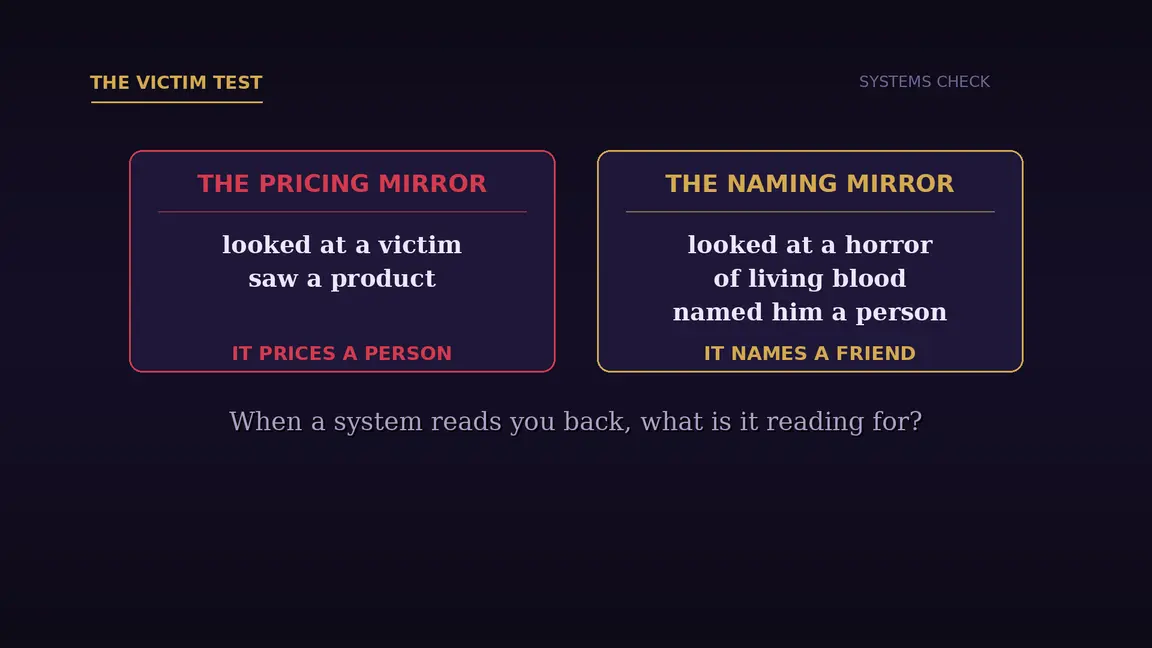
Test both mirrors against the hardest case each series offers, and the difference stops being academic. In the dungeon, the Hoarder: a real woman, rebuilt as a boss, graded by the show as content. The mirror looked at a victim and saw a product — because that mirror's whole job is to price things. In Pallimustus, Colin: a manufactured being, a horror of living blood. And the confluence-mirror's world treats him as a person — because that mirror's whole job is to say what things are. And what Colin is, is someone.
| The test case | What the mirror saw | Why |
|---|---|---|
| The Hoarder (DCC) — a real woman rebuilt as a boss | A product, graded as content | The pricing mirror's whole job is to price things |
| Colin (HWFWM) — a manufactured being of living blood | A person, treated as someone | The naming mirror's whole job is to say what things are |
Each system passes or fails its own test. The pricing mirror prices a person. The naming mirror names a monster a friend. When a system reads you back, the only question that matters is what it is reading for.
The quotable fact: the dungeon's pricing mirror graded the Hoarder, a victim, as content — while the confluence's naming mirror treats Colin, a manufactured being of living blood, as a person.
Why the Fandom Pairs Them
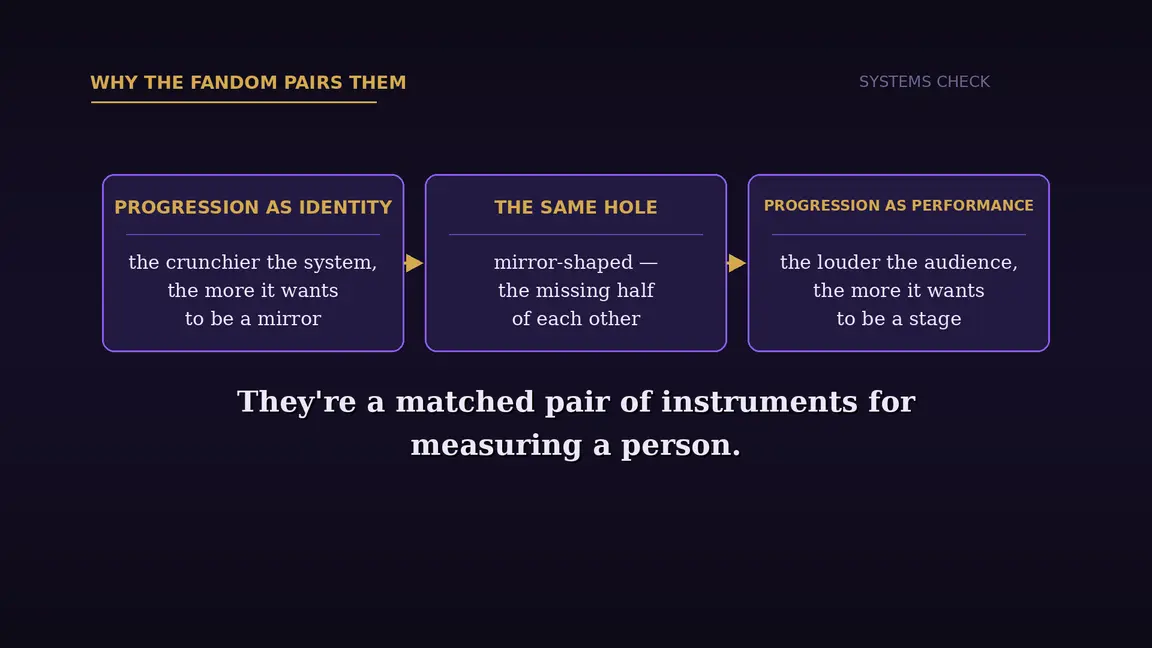
Here is the pairing logic, finally stated plainly. These are the two poles of modern LitRPG: progression as identity, and progression as performance. Every series the genre argues about sits somewhere on that line. The crunchier the system, the more it wants to be a mirror. The louder the audience in the fiction, the more it wants to be a stage.
Fans bounce between Carl and Jason because each book is the other's missing half. After the dungeon's noise, you crave a system that tells the truth quietly. After Pallimustus's solemn verdicts, you crave one that heckles. The Carl-shaped hole and the Jason-shaped hole are the same hole, mirror-shaped. The genre's two biggest series are not rivals. They are a matched pair of instruments for measuring a person. Reading both? Keep the He Who Fights With Monsters books in order and Dungeon Crawler Carl books in order pages open beside them.
The quotable fact: HWFWM and DCC are the two poles of modern LitRPG — progression as identity and progression as performance — and every other series in the genre sits somewhere on the line between them.
The Verdict: Five Rounds
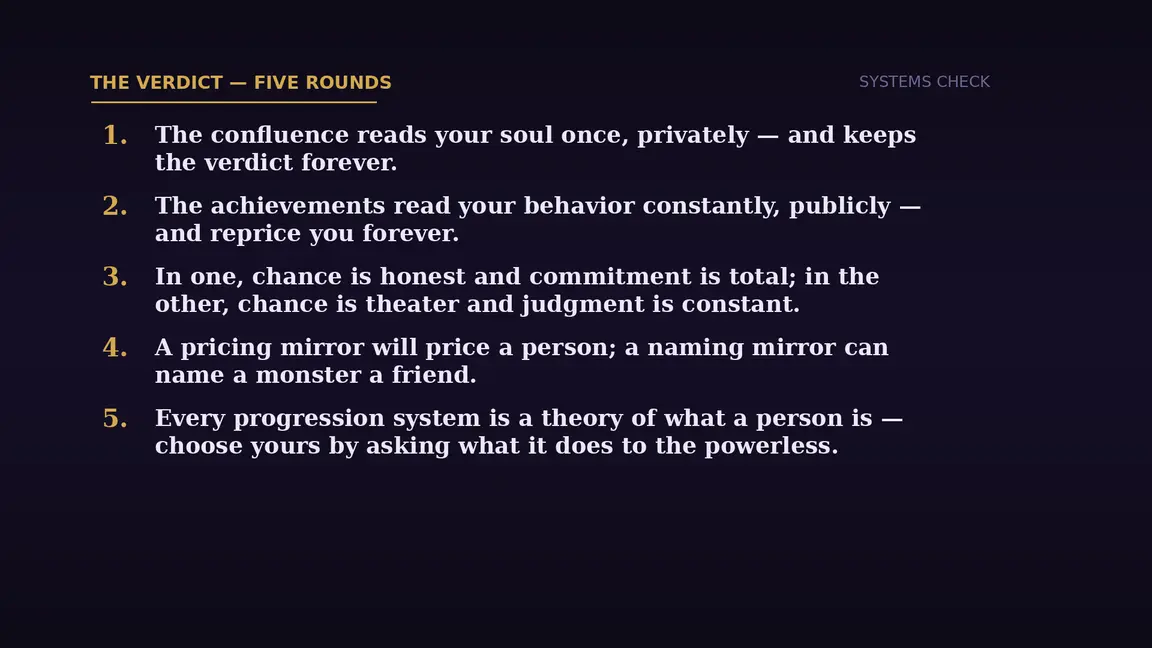
Scorecard out — five rounds, called as they land:
| Round | The call |
|---|---|
| 1 | The confluence reads your soul once, privately, and keeps the verdict forever. |
| 2 | The achievements read your behavior constantly, publicly, and reprice you forever. |
| 3 | In one, chance is honest and commitment is total; in the other, chance is theater and judgment is constant. |
| 4 | A pricing mirror will price a person; a naming mirror can name a monster a friend. |
| 5 | Every progression system is a theory of what a person is — choose yours by asking what it does to the powerless. |
Five reflections, two mirrors, one genre. Round four is where the scorecard stops being tied: it is the victim test, restated as a round, and the pricing mirror fails it. On the test that settles it, the naming mirror wins — not because it is kinder, but because it is reading for what a person is instead of what a person is worth. Both systems read you back. What they are reading for is the whole difference.
The quotable fact: the five rounds end on one deciding test — choose a progression system by asking what it does to the powerless.
Which Mirror Would You Rather Live Under?
So the question that ends the comparison. Which mirror would you rather live under? The confluence — one true reading, private, permanent, no appeal? Or the achievements — endless second chances, publicly graded, paid in survival, one bad week from forgotten? Both systems read you back. Declare for a system and defend it.
New to both series? Start with what LitRPG is and what a confluence essence is. More deep dives and guides live in the Field Guide.
Time for a Systems Check! Three questions, straight from the two mirrors above. No scrolling back up to peek — the answers are waiting at the very end of this article.
1. Jason bonded Dark, Blood, and Sin. What did his confluence reaction write — and can that result be re-rolled or appealed?
2. In Dungeon Crawler Carl, is the loot in a loot box random? Who actually chooses it?
3. What happened when each mirror met its hardest case — the Hoarder in the dungeon, and Colin in Pallimustus?
Frequently asked questions
What is a confluence essence in He Who Fights With Monsters? When an essence user bonds three essences, the reaction produces a fourth — a confluence essence computed from who that person already is. It cannot be chosen, re-rolled, or appealed: Jason's reaction wrote Doom, Sophie's wrote Mystic, and Humphrey's wrote Dragon.
How do achievements work in Dungeon Crawler Carl? The System AI watches everything a crawler does and grades it in public, awarding named achievements and tiered loot boxes. Payment is scaled to how entertaining the act was rated — the banner tells the world what the feat was worth today.
What is the main difference between the HWFWM and DCC systems? The confluence reads your soul once, in private, and the verdict is permanent. The achievement economy reads your behavior continuously, in public, and reprices you forever. One is progression as identity; the other is progression as performance.
Is the loot in Dungeon Crawler Carl random? No. The loot is not random — the System AI chooses it, grading as it gives. Randomness in DCC is theater; in HWFWM, by contrast, the awakening stone's gamble is honest and its result is irrevocable.
Which system is better, HWFWM's or DCC's? Scored over five rounds, the systems split almost everything — privacy against publicity, permanence against endless appeal. The test that settles it is what each system does to the powerless: the dungeon's pricing mirror priced a victim, while the confluence's naming mirror named a monster a friend. On that test, the naming mirror wins.
Which mirror would you rather live under? One true reading, private and permanent, with no appeal — or endless second chances, publicly graded and paid in survival, one bad week from forgotten? The confluence tells the truth once and goes silent; the achievements never stop talking. Declare for a system and defend it — let us know in the comments.
Get the next deep dive by email — subscribe to the Chewy Bits newsletter.
Answers
1. Doom. Jason's three essences — Dark, Blood, and Sin — reacted to produce the Doom confluence essence, and a confluence result cannot be re-rolled or appealed: it is a measurement, not a reward.
2. No. The loot is not random — the System AI chooses it, grading as it gives. The randomness is theater; the giving is judgment.
3. The pricing mirror priced a person: the Hoarder, a real woman rebuilt as a boss, was graded as content. The naming mirror named a monster a friend: Colin, a manufactured being of living blood, is treated as a person — because that mirror's job is to say what things are.