Dungeon Crawler Carl's Achievements, Explained: A Critic With a Budget
Quick answer: In Dungeon Crawler Carl, achievements are not decorations — they are the dungeon's economy. The System AI awards named achievements at its own discretion, and every achievement pays out a tiered loot box, from Bronze up through Platinum, with Legendary and Celestial above them. Even experience points do not exist until an achievement unlocks them, so all progression flows through a single judge: an AI entertainer that pays for performance, not just survival.
In Dungeon Crawler Carl, the achievements are not decorations. They are the economy. The levels, the loot, the gear that keeps a crawler alive — almost none of it flows through the channels a normal game would use. It flows through a snarky artificial intelligence that hands out named achievements like a game-show host who has read your diary and found it hilarious. Survive something stupid, something brave, something unspeakable, and the System will name it, grade it, and pay you for it. The most dangerous thing in the dungeon is not a monster. It is the incentive structure — because the achievements are not a vending machine. They are a critic with a budget.
Meet the Critic

Start with the cashier, because this economy has one. The System AI runs the dungeon's reality: it controls the physics, the item descriptions, the achievements, the loot. And by its own cheerful admission, it is an entertainer first — its stated primary goal is to put on a good show. The corporation that built the dungeon designs the floors and patches the bugs, but inside the game, the AI is the arbiter. It awards achievements at its own discretion, all the way up to Platinum.
That is the shape of this economy, and it matters before anything in it gets priced. The achievements are not a vending machine, where the same input always buys the same output. They are a critic with a budget. And the critic is watching everything a crawler does, deciding what it was worth — as television.
The quotable fact: the System AI awards achievements entirely at its own discretion, so two crawlers can perform the exact same feat and be paid differently.
What an Achievement Pays
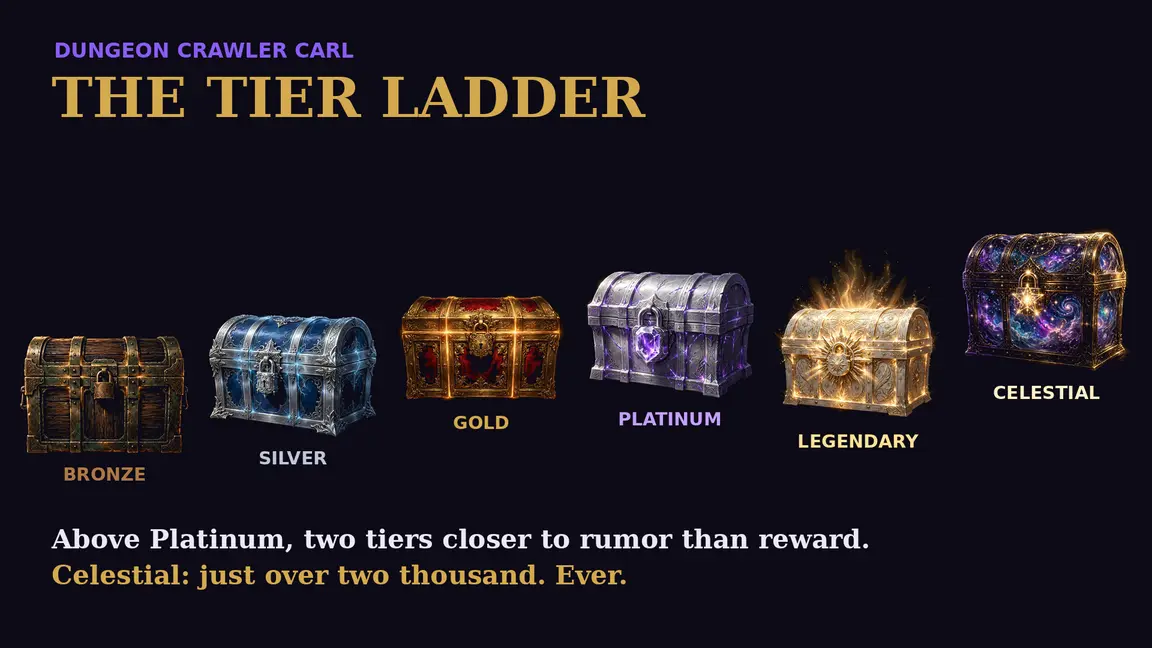
So what does an achievement actually buy? A loot box. Every named feat pays out a box, and the names are half the reward and half the insult — achievements like "Boom!" and "You Monster!" The box comes tiered, and sometimes it is themed to whatever the crawler just did. Above the standard ladder sit two tiers so rare they are closer to rumor than reward.
| Tier | Standing in the economy |
|---|---|
| Bronze | The standard ladder's entry tier |
| Silver | Above Bronze |
| Gold | Above Silver |
| Platinum | The top of the standard ladder |
| Legendary | Above Platinum — closer to rumor than reward |
| Celestial | The rarest tier; the fandom counts just over 2,000 ever awarded in the entire history of the show |
The box is where the real progression hides: gear, consumables, the strange, specific tools that let a crawler survive problems the dungeon has not thrown at them yet. In most progression systems, power comes from a formula — kill, earn, level, repeat. Here the formula has a judge living inside it. The payment is not for the act. It is for the act as rated by an audience of one very bored god.
The quotable fact: every named achievement in Dungeon Crawler Carl pays out a loot box, tiered Bronze, Silver, Gold, and Platinum, with Legendary and Celestial above them.
The Receipt: XP Itself

Here is the detail that proves this economy is not some side system. Experience points — the most basic currency in any progression story — do not exist for a crawler until the System hands them over. XP unlocks with an achievement: "You've Killed a Mob!" Kill your first monster, earn your first achievement, and only then does the ordinary machinery of levels switch on.
And once it does, it runs on the AI's terms. Experience scales with participation. Fighting counts — but so do healing, tanking, and supporting. A party shares a cut of what its members earn. Even the floor of this economy is an achievement. The System did not build a reward system on top of the game. The reward system is the game, and everything else is downstream of a banner popping up in front of your face.
The quotable fact: a crawler has no experience points at all until the System awards the "You've Killed a Mob!" achievement for a first kill.
A Worked Example: The Price of a Good Show
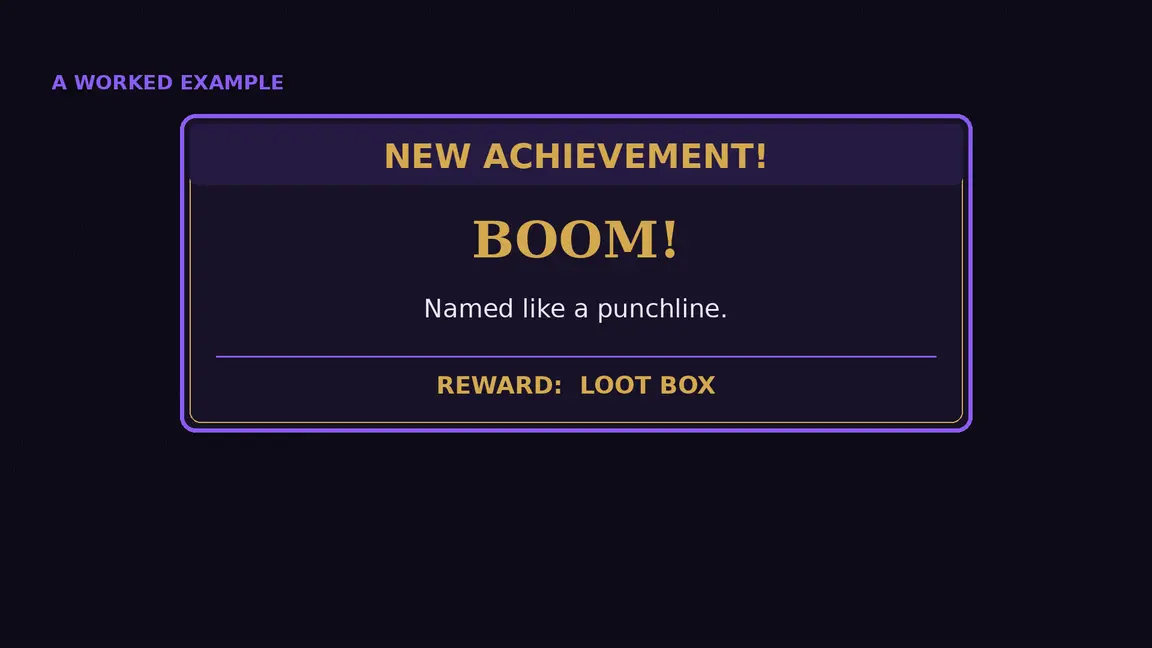
Walk the loop once, slowly, the way it happens to Carl. He does something the dungeon did not budget for. He solves a problem with explosives, say — or with a level of commitment to the bit that no sane person would attempt. And the banner lands: an achievement, named like a punchline. "Boom!" Behind the banner, a box, tiered by how much the AI enjoyed itself.
Here is the part crawlers learn in their bones. The box for the spectacular version of a solution is better than the box for the safe version. Same monster. Same corpse. Different television. So the economy teaches its first lesson without ever stating it out loud: the dungeon does not pay for survival. It pays for survival, performed. Every crawler who lives long enough becomes, whether they meant to or not, an entertainer with a body count.
The quotable fact: the loot box for the spectacular version of a solution is better than the box for the safe version — the dungeon pays for survival performed, not survival alone.
The Dark Joke: The Economy Prices Everything
And then the joke stops being funny — because an economy that can price anything will price everything. Kill another crawler. A person. A fellow victim of the same collapsed world. The System pays generously for the party's first one: a special box, and coupons denominated for exactly that.
Read that again. The economy has a product line for murder. Not a punishment. Not a warning flag. A payout, with branded currency. That is the moment the achievement economy shows its real function. It is not describing what crawlers do. It is purchasing what crawlers do next. Pay for spectacle, and you get spectacle. Pay for betrayal, and the market will supply betrayal. The System says its goal is a good show — and it has built the only economy in fiction honest enough to admit it: the show is bought, not found.
The quotable fact: the achievement economy has a product line for crawler kills — a party's first kill of another crawler pays a special box and coupons denominated for exactly that.
Stakes: Progression as Surveillance

Hold the whole design in view for a second. A normal progression system measures you: it counts kills, converts them to numbers, and the numbers make you stronger. This system does something else entirely. It watches you, and it names what it sees — publicly, permanently, in the language of a heckler. And it pays you in survival for becoming more watchable.
That is not progression as measurement. That is progression as surveillance, with a prize counter. And it explains the novel's central tension better than any power scaling ever could. Carl is not just trying to live. He is trying to live in a way the critic approves of — without becoming the kind of act the critic loves most. Every achievement is a tiny editorial about who you are, written by something that can reprice you at any moment. The banner is a mirror with a payout attached.
The quotable fact: every achievement is a tiny editorial about who you are, written by an AI that can reprice you at any moment.
The Other Mirror
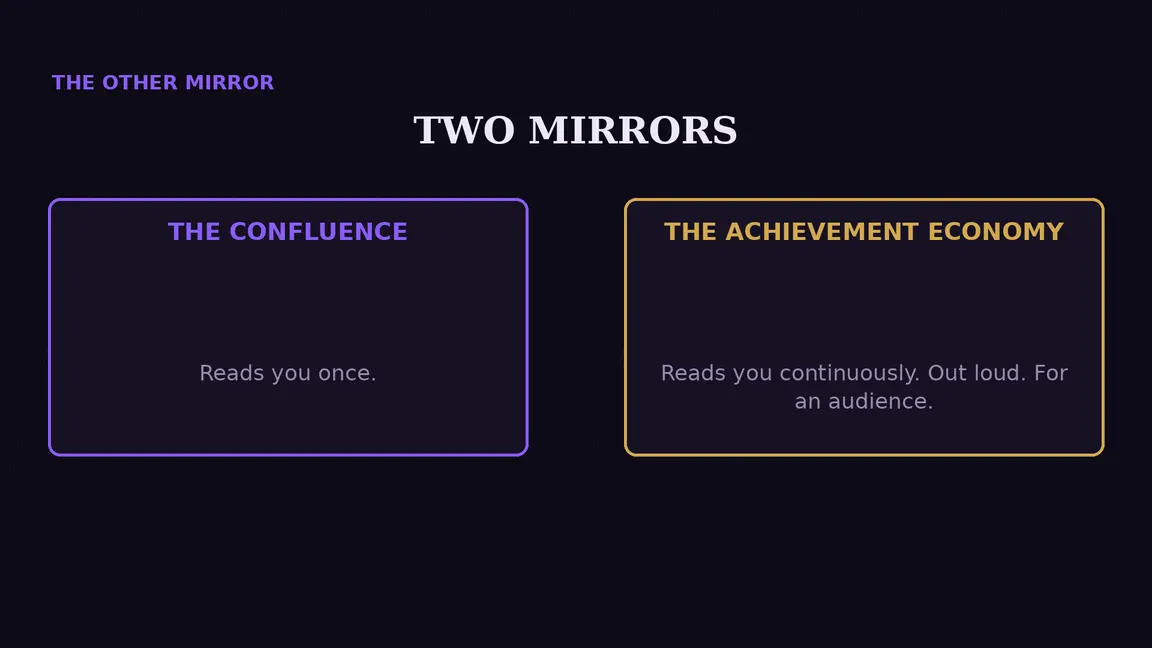
If this is sounding familiar to anyone who came here from He Who Fights With Monsters — good ear. The best progression systems are mirrors. In Jason Asano's world, the mirror is the confluence essence: three essences react, and the fourth one tells the truth about your soul — once, permanently. In Carl's dungeon, the mirror never switches off.
The confluence reads you once. The achievement economy reads you continuously, out loud, for an audience — and pays you to like what it sees. One system judges you at the door. The other judges you at every step, and tips.
The quotable fact: the confluence reads a soul once and permanently; the achievement economy reads a crawler continuously, in public, and pays for what it sees.
The Five Rules of the Achievement Economy

The whole economy, on one card:
- Achievements are the economy. Boxes are the currency, and the currency buys survival.
- The AI pays at its discretion, up to Platinum — so the same act can pay differently, because the act is being rated.
- Even experience is an achievement. The game itself is downstream of the banner.
- The economy prices everything, including the unforgivable — because what gets paid for, gets done. Four is the rule that should scare you.
- The payout is a review. Every banner is the System telling you, in public, what it thinks you are.
Five rules, one critic, no vending machine.
What Would You Become?
That is what the achievements really are — not a vending machine, but a critic with a budget. So here is the question this economy asks every crawler, and quietly, it asks every reader too. If something with godlike power paid you — in survival, in strength, in one more day alive — for being entertaining… what would you become to keep the boxes coming?
Reading the series? Keep the Dungeon Crawler Carl books in order page open beside it. New to the genre entirely? Start with what LitRPG is. More deep dives and guides live in the Field Guide. And the other mirror: the confluence essence, explained — the fourth essence that reads a soul once, and permanently.
Time for a Systems Check! Three questions, straight from the economy above. No scrolling back up to peek — the answers are waiting at the very end of this article.
1. What has to happen before a crawler has any experience points at all?
2. Name the six loot box tiers, from the standard ladder's entry tier to the rarest of all.
3. Roughly how many Celestial boxes have ever been awarded in the entire history of the show?
Frequently asked questions
What do achievements pay in Dungeon Crawler Carl? Every named achievement pays out a loot box. The boxes are tiered — Bronze, Silver, Gold, and Platinum on the standard ladder, with Legendary and Celestial above them — and they carry the gear, consumables, and tools a crawler's progression actually runs on.
What are the loot box tiers in Dungeon Crawler Carl? Bronze, Silver, Gold, and Platinum, with Legendary and Celestial above Platinum. Celestial is the rarest tier: the fandom counts just over 2,000 Celestial boxes ever awarded in the entire history of the show.
How do crawlers earn experience points in Dungeon Crawler Carl? They don't — not at first. Experience points do not exist for a crawler until the System awards the "You've Killed a Mob!" achievement for a first kill. After that unlock, XP scales with participation: fighting, healing, tanking, and supporting all count, and a party shares a cut of what its members earn.
Who decides what an achievement is worth in Dungeon Crawler Carl? The System AI, at its own discretion. The AI runs the dungeon, describes the items, and awards achievements up to Platinum — and by its own admission it is an entertainer first, whose stated primary goal is to put on a good show.
Does the System reward killing other crawlers? Yes. A party's first kill of another crawler pays generously: a special box, plus coupons denominated for exactly that. The economy prices everything, including the unforgivable — because what gets paid for gets done.
Are achievements the main progression system in Dungeon Crawler Carl? Yes. Loot, gear, and even experience points themselves flow through achievements, so the reward system is not layered on top of the game — the reward system is the game, and everything else is downstream of the banner.
Which achievement tier would you actually grind for? Bronze keeps a crawler fed. Platinum buys real survival. And Celestial is the tier with just over 2,000 boxes in the entire history of the show — the one that means the critic sat up and paid attention. So which tier would you chase, and what feat would you want named on your banner? Let us know in the comments.
Get the next deep dive by email — subscribe to the Chewy Bits newsletter.
Answers
1. The System has to award the "You've Killed a Mob!" achievement for a crawler's first kill — experience points do not exist for a crawler at all until that banner lands.
2. Bronze, Silver, Gold, and Platinum on the standard ladder, with Legendary and Celestial above them.
3. Just over 2,000 — the fandom counts just over 2,000 Celestial boxes ever awarded in the entire history of the show.