Fame Is a Survival Stat: Views, Followers, Sponsors, Explained
Quick answer: In Dungeon Crawler Carl, fame is a survival stat. The crawl tabulates every crawler's views, followers, favorites, and sponsors, and that audience converts into real protection — sponsorship, favorable rulings, and the show's reluctance to kill its stars. A crawler nobody watches is a crawler the show can afford to lose.
Every crawler in Dungeon Crawler Carl has two health bars. One of them is hit points, and it works the way you think. The other one is invisible, printed on no character sheet — and it is the one that actually decides who lives. Views. Followers. Favorites. Sponsors. The audience watching a crawler is a resource, spent and earned like mana, and the numbers behind the numbers explain why the most dangerous stat in the series is the one that measures being seen.
The Numbers Are Real Numbers
This is not a metaphor the fandom invented; the show keeps books. By the second floor — the second — the reported metrics on the crawl have already exploded, with hundreds of millions of followers and favorites counted alongside the views. Sit with the scale of that. The dungeon is the most-watched event in the history of everything, broadcast across a galaxy, and every crawler inside it is a channel.
| Audience metric | How the show treats it |
|---|---|
| Views | Tabulated from the crawl's earliest floors, on a galactic broadcast |
| Followers | Counted in the hundreds of millions alongside the views |
| Favorites | Counted in the hundreds of millions alongside the views |
| Sponsors | The patronage layer — support that flows only toward the watched |
The interface tracks a crawler's audience the way it tracks their health, because in this economy the two are linked line items. When we say fame is a stat, we mean the fiction literally tabulates it — and then prices people by it.
The quotable fact: the crawl's interface tracks views, followers, favorites, and sponsors as tabulated numbers, and prices crawlers by them.
Why Views Keep You Alive
So what does an audience actually do for a crawler? Start with the obvious: sponsors. Crawlers who entertain attract sponsors, and sponsors mean support that does not come out of a loot box. The show's economy has a patronage layer — and it only flows toward the watched.
But it goes deeper than gifts. A popular crawler is expensive to kill: the show is a business, and the audience has favorites. The AI's discretion. The producers' patience. The edge-case rulings. The whole apparatus leans, subtly and constantly, toward keeping its stars on stage. Nobody in the dungeon is safe. But some crawlers are load-bearing, and they know it, and the knowledge changes how they play. Fame is not vanity in there. It is armor made of other people's attention.
The quotable fact: a popular crawler is expensive to kill, because the show's discretion, patience, and edge-case rulings all lean toward keeping its stars on stage.
The Leaderboard: Fame, Ranked
And because this is a game show, the fame is ranked. The Leaderboard publishes the top ten crawlers — names, standings, and the detail that gives the whole system its teeth: bounties.
| The Leaderboard | What it does |
|---|---|
| Publishes | The top ten crawlers, with names and standings |
| Prices | Bounties on the ranked — the top crawler on the Fourth Floor tables carries a million-credit bounty |
| Announces | The system itself announces it when a top-ten crawler is killed |
Consider what a bounty does to the fame economy. It converts popularity into a price on your head — payable to anyone willing to collect. Being watched keeps you alive, and paints the target that gets you killed. The Leaderboard is the dungeon's perfect little machine. It makes fame visible. It makes visibility valuable. And it makes value lethal — all in one public table.
The quotable fact: the Leaderboard publishes the top ten crawlers with bounties attached, and the top crawler on the Fourth Floor tables carries a million-credit bounty.
Viral: The Royalties of the Damned
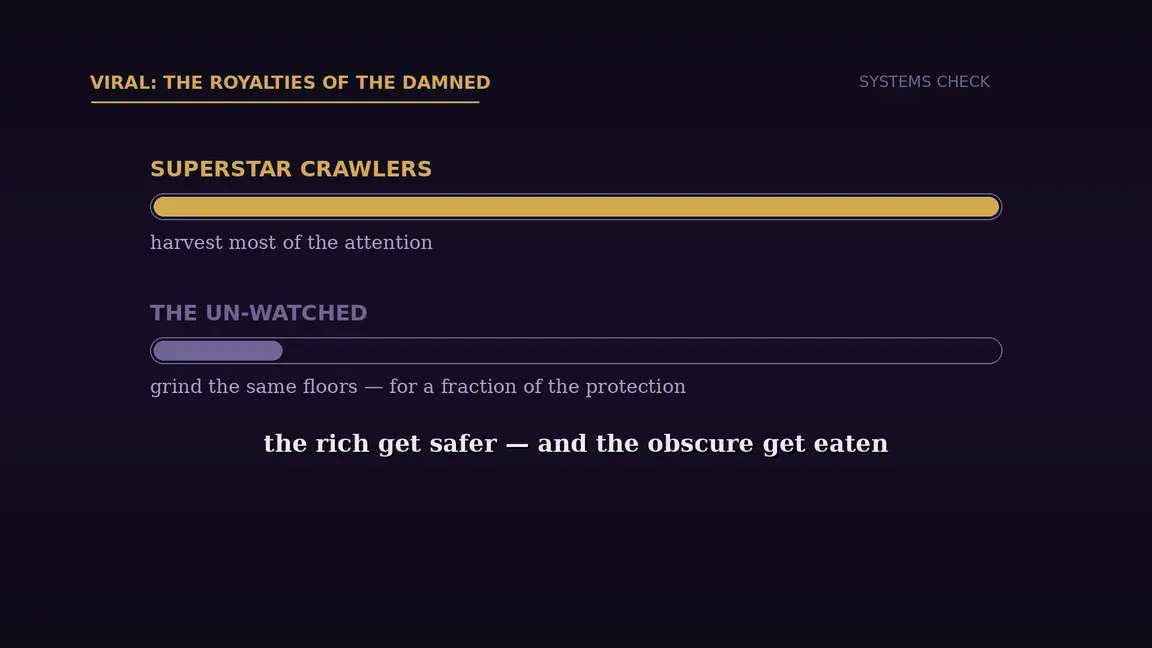
There is a chapter title in the fan summaries that tells you everything about this economy: "Viral Fame and Royalties." Royalties. The crawlers are not just content. They are talent — with something resembling an entertainment industry's economics wrapped around their survival. Audiences. Metrics. Payouts. Fame compounding like interest.
And like every entertainment economy, it stratifies brutally. A tiny number of superstar crawlers harvest most of the attention. Thousands of the un-watched grind the same floors for a fraction of the protection. The dungeon reproduced show business exactly, including its cruelty. In the fame economy, the rich get safer and the obscure get eaten. If that feels uncomfortably familiar as a description of the internet, sit with it. The series means it to.
The quotable fact: the fame economy stratifies — a tiny number of superstar crawlers harvest most of the attention, while thousands of un-watched crawlers grind the same floors for a fraction of the protection.
The Dark Joke: Attention Is the Currency of the Critic
Now connect the two economies, because they interlock like gears. In our achievement-economy breakdown, loot was the AI's discretion — a critic paying for performance. Fame is what the performance buys at scale: the audience's attention, converted into protection, sponsorship, and price.
Which means the crawler's real job description is the entertainer's: not survive the dungeon, but be worth watching while you do. Every decision gets made twice — once for the fight, once for the feed. A safe play that makes bad television is, in this economy, a genuinely worse play than a dangerous one the audience loves. The dungeon did not just gamify survival. It did something more honest, and more horrifying. It admitted that in any watched world, survival was always partly a popularity contest. In the dungeon, fame is a survival stat. And then it published the standings.
The quotable fact: every crawler decision is made twice — once for the fight, and once for the feed — because a safe play that makes bad television is a genuinely worse play than a dangerous one the audience loves.
Stakes: The Unwatched
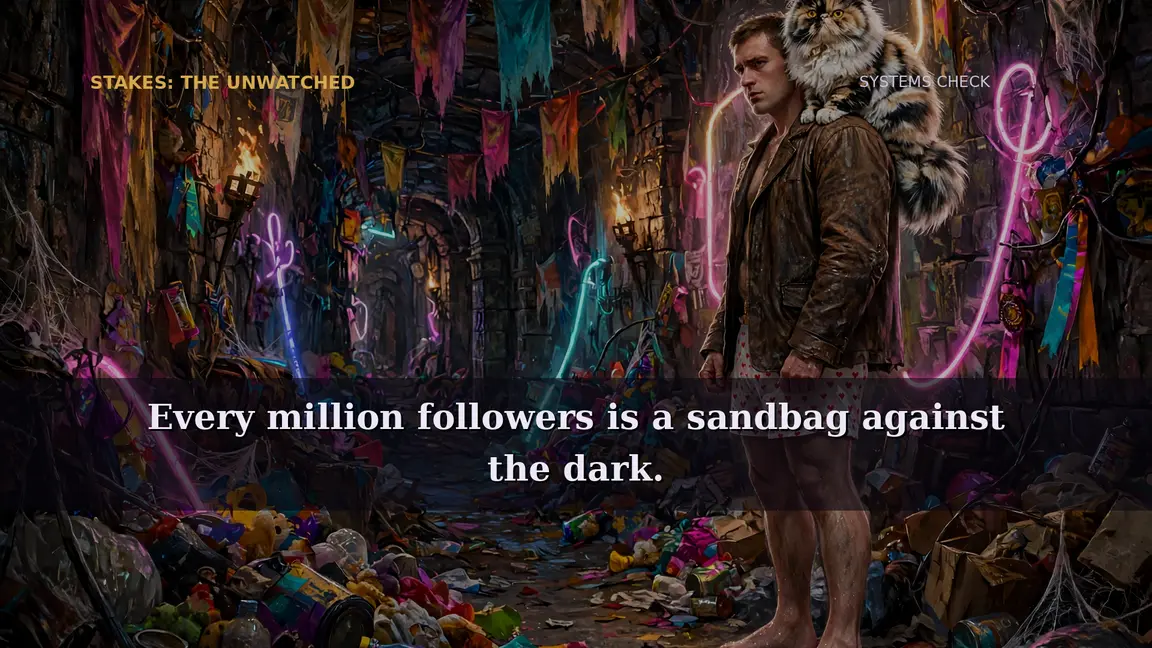
So spare a thought for the stat's shadow: the unwatched. For every superstar on the Leaderboard, the dungeon is full of crawlers with no followers to speak of. No sponsors. No protective fame. No audience to miss them. The show spends nothing on their survival because their deaths cost it nothing.
That is the moral architecture the fame stat builds under the whole series. A world that has priced attention has quietly priced people. And the exchange rate is merciless. It is also why Carl's rise matters emotionally, beyond the comedy of it: every million followers is a sandbag against the dark. The audience out there in the galaxy thinks it is watching a show. The crawlers know they are holding a lifeline. Both are right, and the gap between those two facts is where this series lives.
The quotable fact: the show spends nothing on an unwatched crawler's survival, because an unwatched crawler's death costs it nothing.
The Other Mirror's Answer
We have spent this season inside another system that reads people — and it answers the fame economy point for point. In He Who Fights With Monsters, nobody watches Jason for entertainment; his worth is written once, privately, by a confluence nobody broadcasts. No followers. No leaderboard. No bounty.
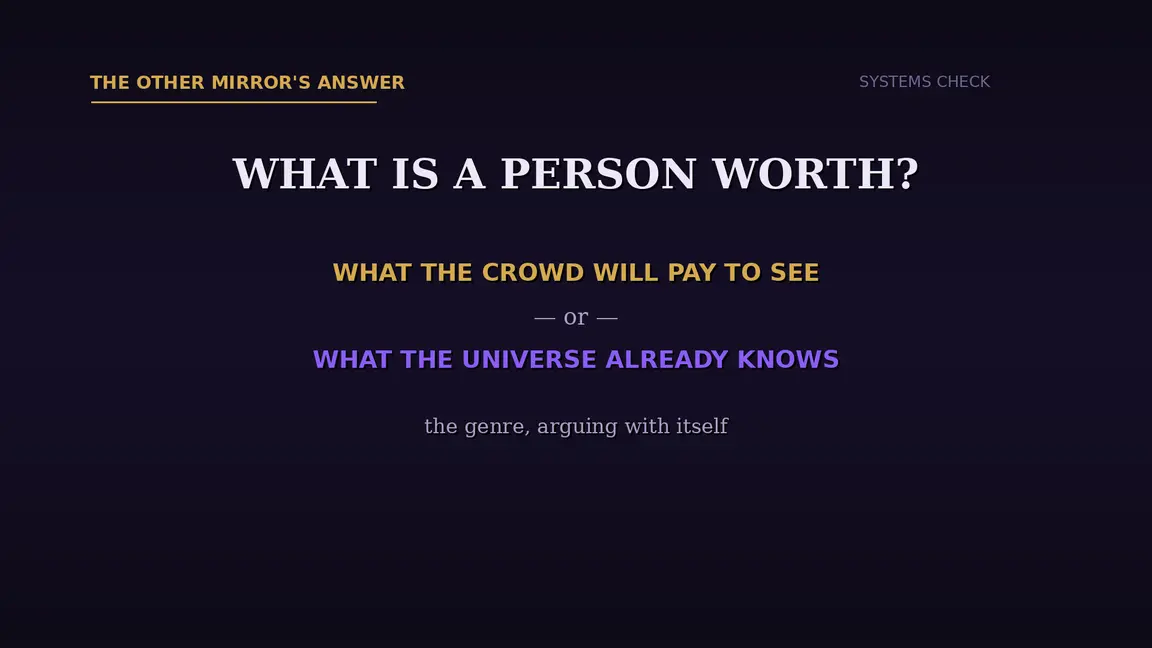
The dungeon prices attention; Pallimustus ignores it — and measures the soul instead. Set the two side by side, and you can feel the genre arguing with itself about what a person is worth. What the crowd will pay to see — or what the universe already knows.
The quotable fact: the dungeon prices attention, while Pallimustus ignores it and measures the soul instead — Jason's worth is written once, privately, by a confluence nobody broadcasts.
Five Laws of the Fame Economy
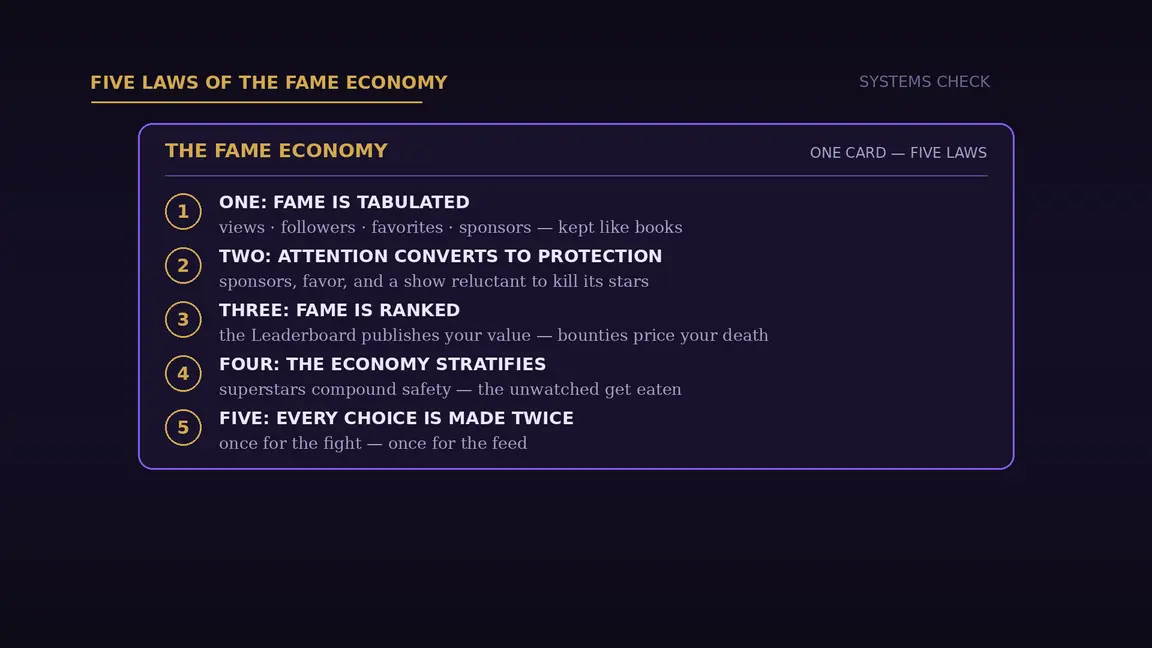
One card, five laws:
- Fame is tabulated — views, followers, favorites, sponsors, kept like books.
- Attention converts to protection — sponsors, favor, and the show's reluctance to kill its stars.
- Fame is ranked — the Leaderboard publishes your value, and bounties price your death.
- The economy stratifies — superstars compound safety while the unwatched get eaten.
- Every choice is made twice — once for the fight, once for the feed.
Five laws, and one stat that was never printed on the sheet — because it is the sheet.
The quotable fact: the fame economy runs on five laws — fame is tabulated, attention converts to protection, fame is ranked, the economy stratifies, and every choice is made twice.
What Would You Become to Stay Watched?
So here is the question the fame economy asks everyone holding a phone right now. If being watched kept you alive — literally, measurably alive — what would you become to stay watched? Carl's answer involves bare feet and explosions. The dungeon's answer is already written in its standings: fame is a survival stat, and the unwatched pay for it.
Reading the series? Keep the Dungeon Crawler Carl books in order page open beside it. New to the genre entirely? Start with what LitRPG is. More deep dives and guides live in the Field Guide.
Time for a Systems Check! Three questions, straight from the fame economy above. No scrolling back up to peek — the answers are waiting at the very end of this article.
1. Which four audience metrics does the crawl tabulate for every crawler?
2. What bounty does the top crawler on the Fourth Floor Leaderboard tables carry?
3. Why is a popular crawler expensive for the show to kill?
Frequently asked questions
Is fame really a tracked stat in Dungeon Crawler Carl? Yes. The crawl tabulates views, followers, favorites, and sponsors for every crawler, and the interface tracks a crawler's audience the way it tracks their health — the fiction literally keeps books on fame, and then prices people by it.
How do sponsors help a crawler in Dungeon Crawler Carl? Crawlers who entertain attract sponsors, and sponsors mean support that does not come out of a loot box. The show's patronage layer only flows toward the watched, so an audience converts directly into resources a loot box never provides.
What is the Leaderboard in Dungeon Crawler Carl? The Leaderboard publishes the top ten crawlers, with names, standings, and bounties attached. The top crawler on the Fourth Floor tables carries a million-credit bounty, and the system itself announces it when a top-ten crawler is killed.
Why is fame dangerous in Dungeon Crawler Carl? Because a bounty converts popularity into a price on your head, payable to anyone willing to collect. Being watched keeps a crawler alive — sponsors, favor, and the show's reluctance to kill its stars — and the same visibility paints the target that gets them killed.
What happens to crawlers nobody watches in Dungeon Crawler Carl? Nothing protects them. Unwatched crawlers have no followers to speak of, no sponsors, and no protective fame, and the show spends nothing on their survival because their deaths cost it nothing — while superstar crawlers compound safety, the obscure get eaten.
Which crawler do you think plays the fame game best? Carl's rise turns every million followers into a sandbag against the dark — but the Leaderboard's top crawlers carry the biggest bounties, and the show announces it when one of them dies. So who plays the fame game best, and does it make them safer — or just a bigger target? Let us know in the comments.
Get the next deep dive by email — subscribe to the Chewy Bits newsletter.
Answers
1. Views, followers, favorites, and sponsors — the four audience metrics the crawl tabulates for every crawler, kept like books.
2. A million-credit bounty. The Leaderboard publishes the top ten crawlers with bounties attached, and the top crawler on the Fourth Floor tables carries the million-credit price.
3. Because the show is a business and the audience has favorites — its discretion, its producers' patience, and its edge-case rulings all lean toward keeping its stars on stage.